
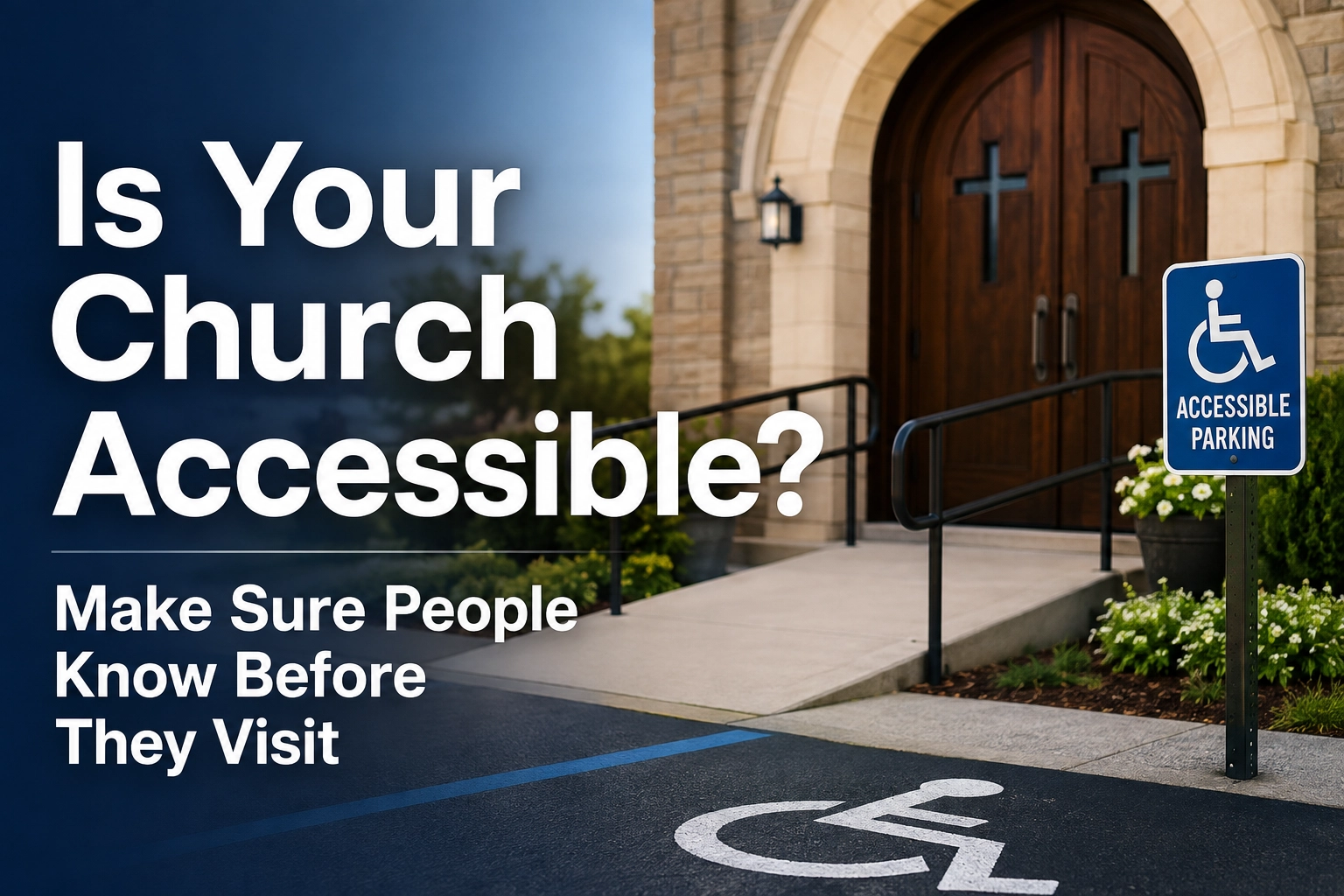
Your church may have accessible parking spaces. You may have a wheelchair-accessible entrance, hearing assistance devices, large-print materials, or accommodations for children with special needs.
But can someone visiting your church for the first time find that information on your website?
For people with disabilities and for families and caregivers planning a church visit, accessibility information can be an important factor in deciding where to worship. No one should have to arrive at a church and discover that they can’t get through the front door, can’t hear the service, or don’t know whether there are accommodations available for their child.
Churches can make the experience much easier by clearly explaining their accessibility features online.
1. Make Your Church’s Location Easy to Find
Before addressing specific accessibility accommodations, start with something every visitor needs: your location.
Your church’s street address should be easy to find without having to search through multiple pages of your website. Ideally, include it in at least one prominent location, such as:
- Your main navigation or a clearly labeled “Visit” or “Plan Your Visit” page (HIGHLY SUGGESTED)
- The website footer (HIGHLY SUGGESTED)
- Your contact page
- A Frequently Asked Questions (FAQ) section
If your accessible entrance is different from your main entrance, say so. For example, “Our wheelchair-accessible entrance is located on the east side of the building next to the accessible parking spaces.”
This is especially helpful on larger church campuses or at churches where the sanctuary, fellowship hall, classrooms, and offices have separate entrances.
2. Clearly List Your Church’s Accessibility Features
Don’t simply say, “Our church is accessible.” That can mean very different things to different people.
Instead, tell visitors exactly what accommodations you provide.
Physical and Wheelchair Accessibility
If available at your church, mention features such as:
- Designated accessible parking
- Step-free or wheelchair-accessible entrances
- Ramps
- Elevators
- Accessible sanctuary seating
- Wheelchair-accessible restrooms
- Wheelchairs available for visitor use
- Accessible fellowship halls, classrooms, or other facilities
If only certain areas of an older church building are accessible, it’s better to explain that clearly than to leave visitors guessing.
Hearing Assistance
People who are deaf or hard of hearing may specifically search for churches offering hearing accommodations.
Your website should state whether you provide:
- Assistive listening devices or headphones
- Hearing loops
- ASL interpretation
- Closed captioning on sanctuary screens
- Closed captions on livestreams or recorded sermons
If ASL interpretation is available only at a particular service, include the service day and time. If visitors need to request an assistive listening device from an usher or welcome desk, tell them where to go.
The goal is to eliminate as much uncertainty as possible before someone walks through the door.
Accommodations for People With Visual Impairments
Consider the needs of people who are blind or have low vision as well.
Does your church offer:
- Large-print bulletins
- Large-print hymnals
- Large-print song sheets or other worship materials
- Braille materials
- Audio versions of church materials
- Assistance navigating the building
Again, specificity matters. If large-print bulletins are available at the welcome desk, say exactly that.
Ministries and Services for Children With Special Needs
For parents of children with disabilities or special needs, knowing what to expect before visiting a church can be especially important.
If your children’s ministry provides accommodations, explain what is available. This might include:
- Special needs ministry programs
- Sensory-friendly rooms or spaces
- Trained volunteers
- One-on-one buddies
- Adaptive Sunday School classes
- Sensory tools
- Quiet areas
- Modified children’s programming
Also explain whether parents should contact the church before attending.
If advance notice helps your ministry prepare the appropriate support, provide a contact name, phone number, email address, or simple online form.
A parent shouldn’t have to make five phone calls just to find out whether their child can participate.
3. Don’t Forget About Website Accessibility
Accessibility begins before someone reaches your building.
Your church website itself should be designed so that people with disabilities can use it.
Among other things, an accessible church website should:
- Work with screen readers
- Include alternative text for meaningful images
- Use descriptive links rather than vague phrases such as “click here”
- Provide sufficient contrast between text and backgrounds
- Allow visitors to navigate the site using a keyboard
- Use headings in a logical order
- Include captions or transcripts when appropriate for video and audio content
- Avoid relying solely on color to communicate important information
- Make forms understandable and properly labeled
Accessibility plugins and widgets can sometimes provide additional tools, but they should not be treated as a replacement for building an accessible website in the first place.
A beautiful church website isn’t truly welcoming if some visitors can’t use it.
4. Why Church Accessibility Information Matters
For many churchgoers, accessibility isn’t a nice extra. It’s part of determining whether attending a church is realistically possible.
Imagine being a wheelchair user and not knowing whether you can enter the building.
Imagine being deaf or hard of hearing and trying to determine whether you’ll be able to follow the sermon.
Imagine being a parent of a child with special needs and having no idea whether the children’s ministry can accommodate your child.
Now imagine finding a church website that answers those questions before you even have to ask.
That communicates something important.
**We thought about you. We want you here.**
Providing accessibility information can also save your church staff time. Instead of answering the same questions individually by phone, email, or social media, your website becomes a reliable resource visitors can consult at any time.
5. People Really Do Search for Accessible Churches
People search online for things like:
- wheelchair accessible churches near me
- churches with ASL interpretation near me
- churches with hearing assistance
- churches with special needs ministries
- churches with sensory rooms
- accessible churches near me
If your church provides these accommodations but doesn’t mention them online, search engines and the people using them may never know.
That’s one reason accessibility information should be written in plain language rather than buried behind internal ministry names.
A ministry called “The Open Door” may be meaningful to your congregation, for example, but a first-time visitor searching for a “special needs ministry” has no way of knowing what The Open Door means.
Use the words people are actually likely to search for.
Make Accessibility Part of Your “Plan Your Visit” Information
One of the simplest solutions is to add an accessibility section to your church’s “Plan Your Visit” or FAQ page.
Tell visitors:
- Where to park
- Which entrance to use
- Which parts of the building are wheelchair accessible
- Whether accessible restrooms are available
- What hearing assistance is offered
- Whether ASL interpretation or closed captioning is available
- What accommodations you provide for people with visual impairments
- Whether you have ministries or accommodations for children with special needs
- Who to contact with accessibility questions
Then keep that information current.
You don’t need an elaborate accessibility program to talk about accessibility. Even a small church can provide helpful information about what it can and cannot currently accommodate.
Clarity itself is a form of hospitality.
List Your Accessibility Features on Salt and Purpose’s Churches Near Me
Salt & Purpose’s Churches Near Me directory helps people find churches based on more than denomination and location. Visitors can also look for churches offering specific ministries, services, and accessibility features.
If your church offers accommodations such as wheelchair accessibility, hearing assistance, ASL interpretation, special needs ministries, or other accessibility services, make sure people can find you.
List your church on Churches Near Me. Church listings are free.
The more information you provide about your church, the easier it is for someone searching for exactly what you offer to discover your congregation.
And for a person who has spent years wondering whether a new place will be able to accommodate them, seeing that information before they arrive can make the difference between continuing to search and deciding:
“I think I can go to this church.”